Ask three software companies what their school ERP costs and you may get three answers that can’t be compared: one per student, one per module, one paid once with a yearly charge after. The cheapest-looking number is often not the cheapest bill.
This guide shows how each kind of price works, what quotes usually leave out, and how to put any two offers side by side.
How school ERPs are priced
Most school software in India is priced in one of three ways. Each can be fair; the trouble starts when two quotes use different ones.
Per student
You pay a fixed amount for each student, every month or every year. The bill grows with your school and shrinks if numbers fall, so it is easy to plan.
Per module
Each part, such as fees, attendance or transport, has its own yearly price. You pay only for what you switch on, but the total can climb as you add parts.
One-time licence
A large first payment, then an AMC every year for updates and support, often a share of the first payment.
- Setup fee
- A one-time charge to create your school’s account and settings.
- Data migration
- Bringing your student list and fee heads in from Excel or old software.
- AMC
- The yearly charge after a one-time licence, for updates and support.
What a quote leaves out
The price on the first page is rarely everything. Before you compare, ask each company for these, in writing:
- SMS and WhatsApp charges, per message or as a pack
- Setup, training and moving your data in
- What a parent pays when they pay fees online
- What happens to your data if you leave
A quick way to find hidden lines: open the quote’s PDF, press Ctrl + F and search for “SMS”, “per” and “extra”.
A worked example: 420 students
Here are three made-up quotes for a school of 420 students, to show the sums.1 Your quotes will differ; the method is what matters.
| Quote | How it’s priced | Year 1 | 3 years |
|---|---|---|---|
| A | ₹8 a student each month | ₹40,320 | ₹1,20,960 |
| B | 4 modules at ₹12,000 a year, plus ₹6,000 for SMS | ₹54,000 | ₹1,62,000 |
| C | ₹1,20,000 licence, ₹15,000 setup, then 18% AMC | ₹1,35,000 | ₹1,78,200 |
Quote C looked like a one-off payment, but over three years it costs the most. The lowest first-year number and the lowest three-year number are often different quotes.
Get every number in writing, in the same quote. The one rule in this guide
Questions to ask on the demo call
A demo call is the best time to get straight answers. Take this list:
- What is the total for three years, with everything?
- Including messages, setup and training
- With and without GST
- Can we export all our data, any time, in Excel?
- Who brings our current data in, and how long does it take?
- What does support cost, and how do we reach it?
You can send the company this before the call:
Hello, we are a school of 420 students.
Please send one quote for three years, with:
- setup, training and data migration
- SMS and WhatsApp charges
- prices with and without GST
Thank you.
Where Scoolin fits
Scoolin is free for schools with up to 100 students. Above that it is ₹5 a student each month, ₹3 for each student above 500, and 30% less when you pay for a year. For 420 students that is ₹25,200 a year on monthly billing, or ₹17,640 on yearly.
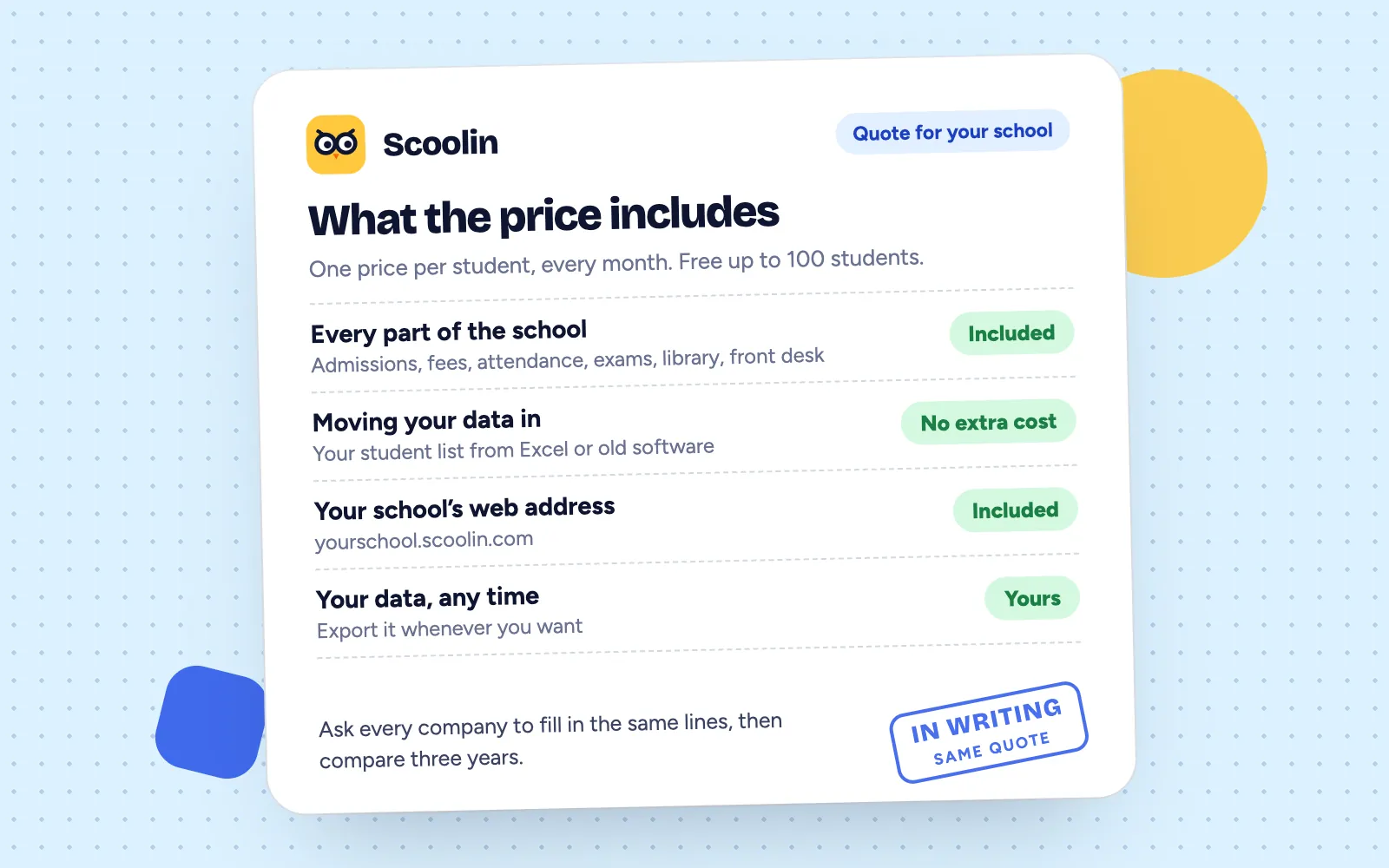
Every school also gets a free web address, like yourschool.scoolin.com, and we move your data in from Excel. See pricing for the details.
Common questions
Is per-student pricing always cheaper?
No. For a very small school, a fixed yearly price can work out lower, and a school that needs only one or two modules may pay less per module. Work out the three-year total for your own student count, with messages and setup added, before you decide.
Should the quote include GST?
Ask for both, in writing. Software is usually charged 18% GST, so a price without it looks 18% lower than the bill you will actually pay. When you compare quotes, put them all on the same footing: every price with GST, or every price without it.
What if our student count changes mid-year?
Ask how the bill changes, and from which month. Per-student prices usually follow the students on your rolls, so the bill goes up with new admissions and comes down when students leave. On a yearly plan, ask whether the price is fixed for the year or adjusted.
Notes
- The three quotes are made up to show the sums. Totals assume prices stay the same for three years and leave out GST. Back to the text